What's the Curvature of a Cube?
1. The Puzzle
A cube’s six faces are flat, and its twelve edges look sharply bent. So where could curvature possibly live?
Surprisingly, all of a cube’s curvature is concentrated at its eight corners.
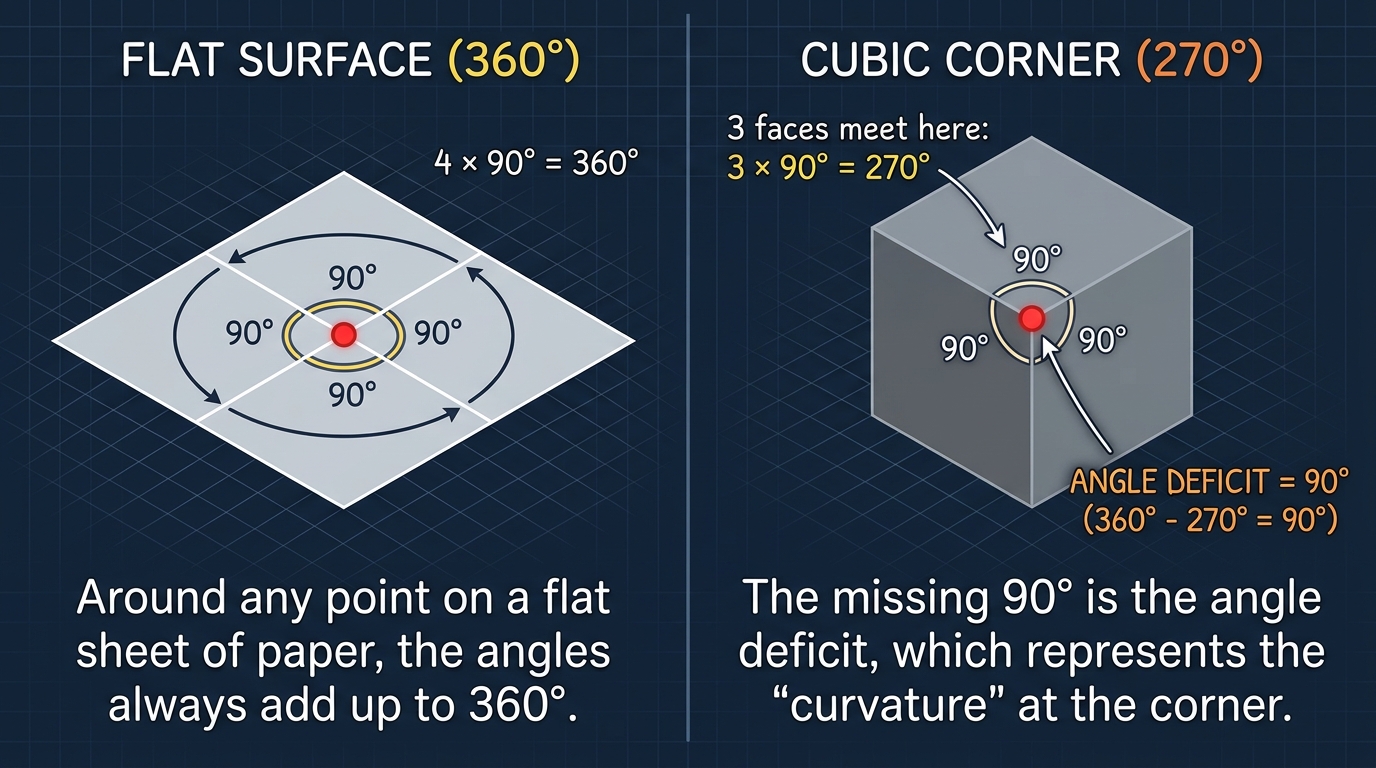
Here is how to see it. On a flat sheet of paper, the angles around any point add up to 360°. Now look at a corner of a cube. Three squares meet there, each contributing a 90° angle, so the angles add up to only 270°. Ninety degrees are missing. That missing amount is called the angle deficit, and it is exactly the curvature sitting at that corner.
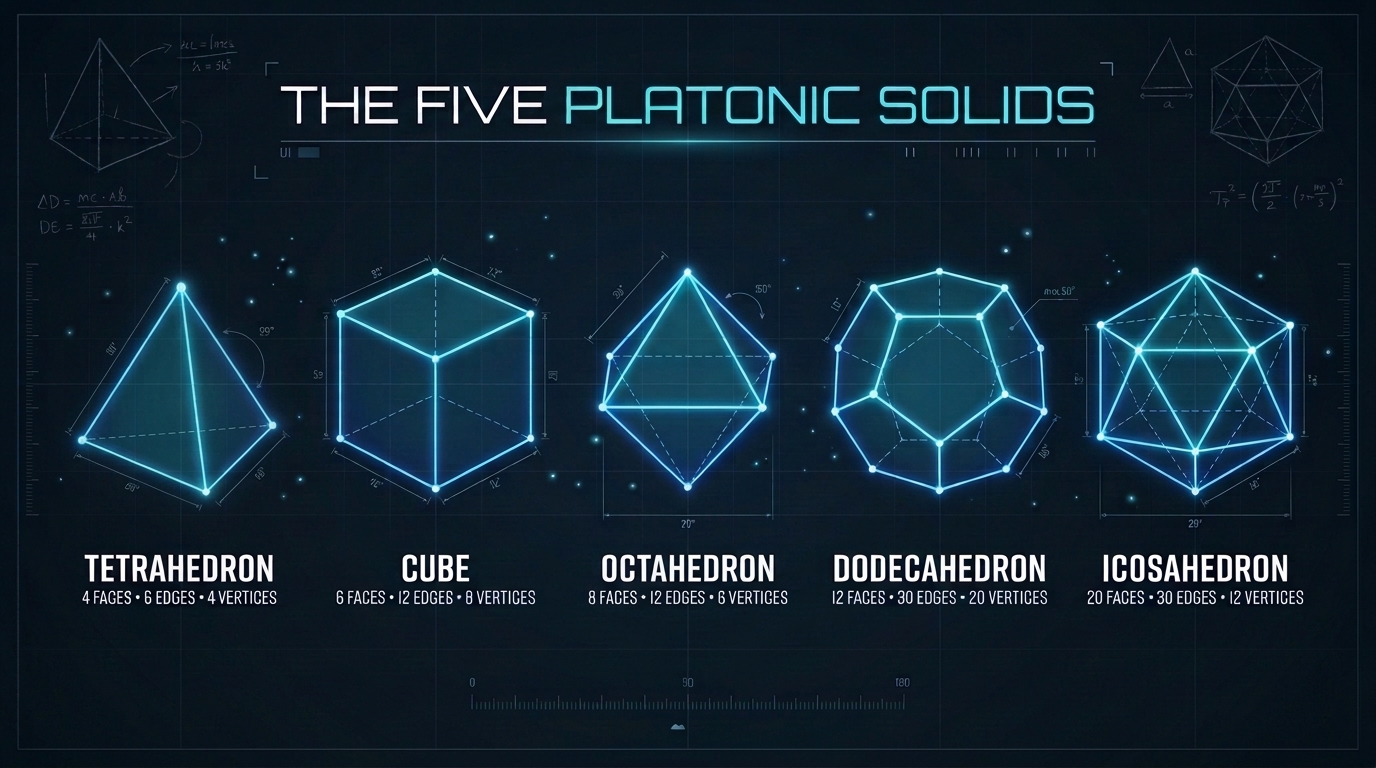
The same recipe works for other shapes:
| Shape | Corners | Angles at each corner | Missing per corner | Total missing |
|---|---|---|---|---|
| Tetrahedron | 4 | 3 × 60° = 180° | 180° ($\pi$) | 4 × 180° = 720° |
| Cube | 8 | 3 × 90° = 270° | 90° ($\pi/2$) | 8 × 90° = 720° |
| Octahedron | 6 | 4 × 60° = 240° | 120° ($2\pi/3$) | 6 × 120° = 720° |
| Dodecahedron | 20 | 3 × 10⁸° = 324° | 36° ($\pi/5$) | 20 × 36° = 720° |
| Icosahedron | 12 | 5 × 60° = 300° | 60° ($\pi/3$) | 12 × 60° = 720° |
Different shapes, different numbers of corners, same total: 720°, which is $4\pi$ in radians. The octahedron and dodecahedron give 720° too. Why? Section 4 answers that. First, what about those bent edges?
2. Edges: Bent, but Not Curved
Take a point on a cube’s edge. On each side lies a flat face, contributing 180° + 180° = 360°. Nothing is missing, so there is no curvature there.
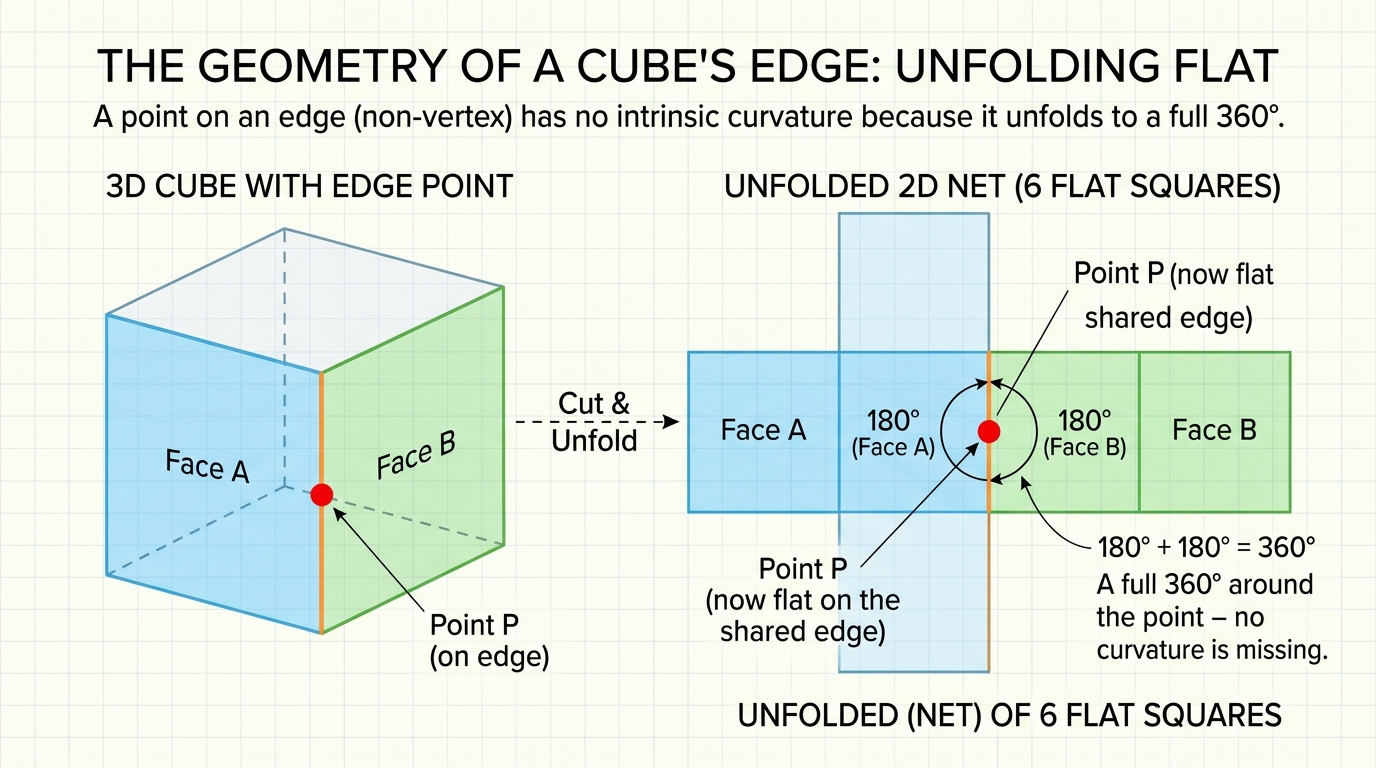
You can also see it by unfolding. A cube can be cut open and laid out as six flat squares. Folding the paper does not stretch or tear it, so distances measured along the surface remain unchanged. An ant crawling across an edge, able to measure only along the surface, would detect no intrinsic curvature.
At a corner, it is different. To flatten it without stretching or tearing, you must cut or crumple the paper. That's the sign of curvature.
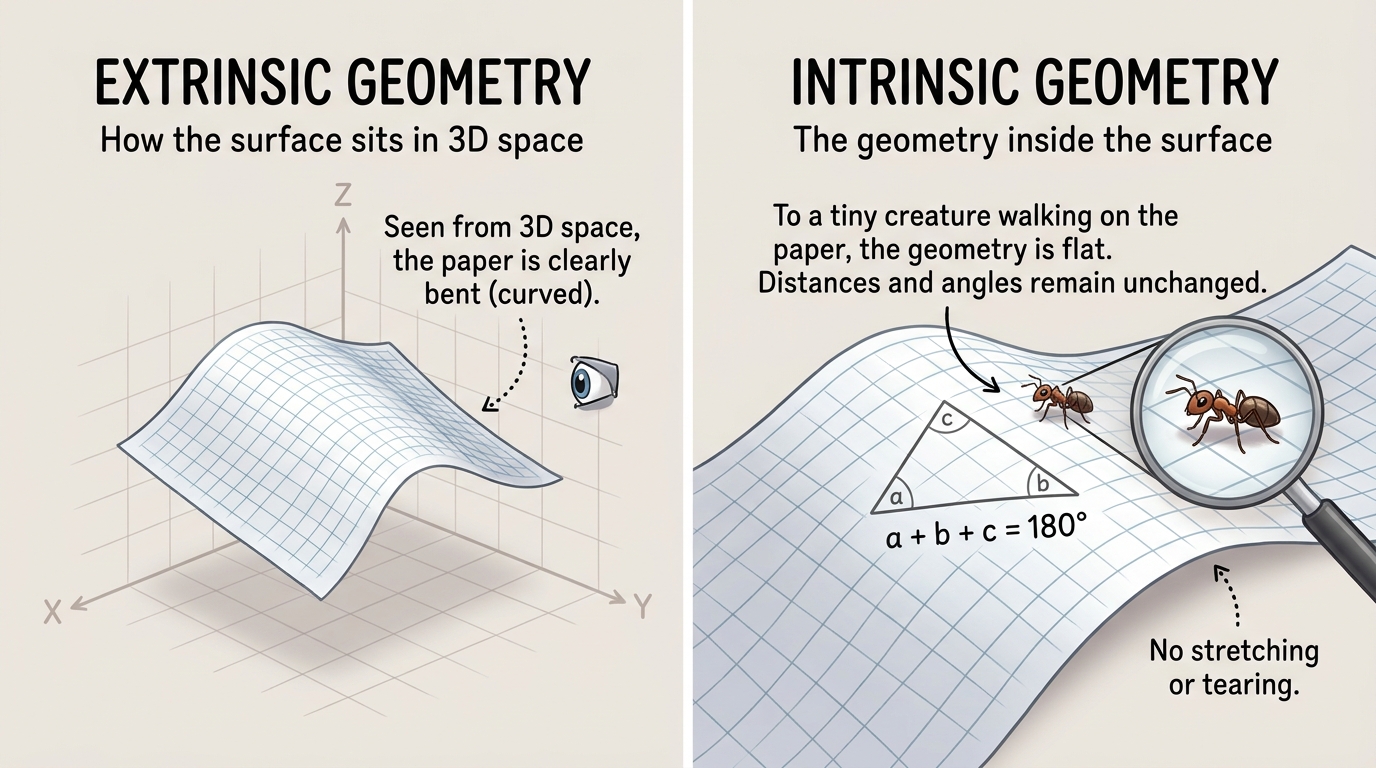
The bend along an edge is real, but it is a fact about how the surface sits in 3D space, not about the geometry inside the surface. Mathematicians call the first kind (how the surface sits in 3D space) extrinsic and the second kind (the geometry inside the surface) intrinsic.
3. Inside Versus Outside
A cylinder makes the distinction clear. Roll a sheet of paper into a tube: it looks curved in space, yet you never stretched it, and it unrolls back to a flat plane. Its intrinsic geometry is flat. This is the core of Gauss’s famous Remarkable Theorem (Theorema Egregium): curvature seen from inside a surface depends only on distances measured within it, not on how the surface is bent in space.
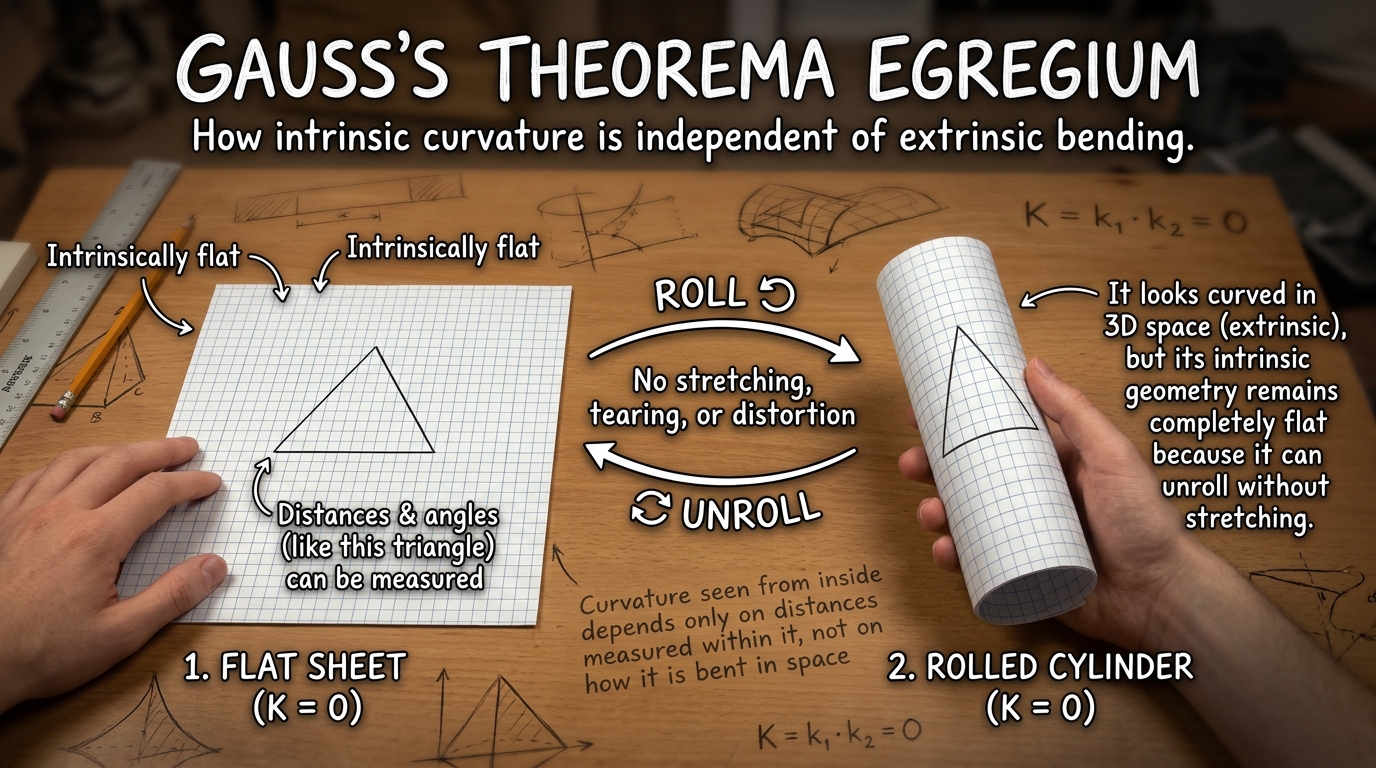
To measure the two views, look at how much a surface bends in its most-curved direction and in the perpendicular direction. Call these two bends $k_1$ and $k_2$.
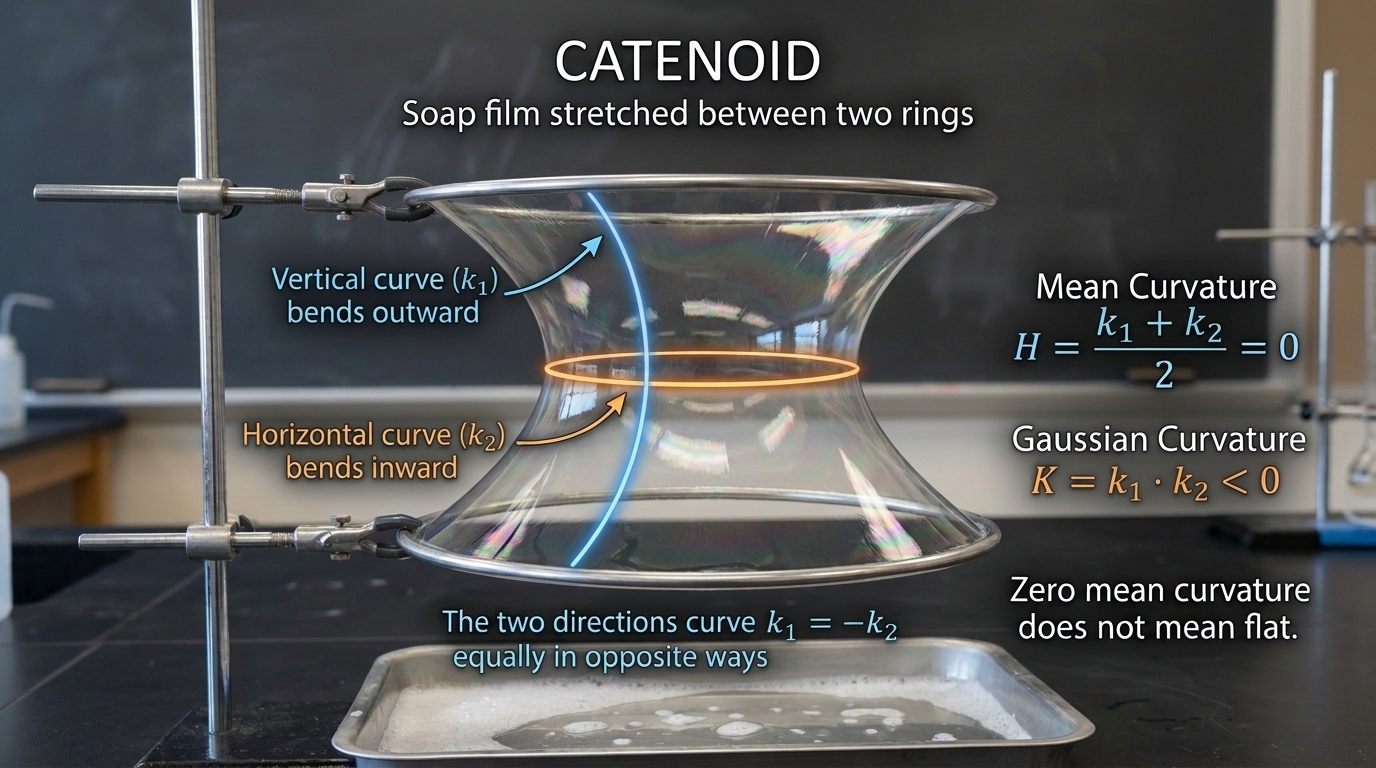
On a cylinder, one direction curves and the other is straight, so $K = 0$ but $H \neq 0$. On a catenoid (the shape of a soap film stretched between two rings), the two directions curve equally in opposite ways, so $H = 0$ but $K$ is negative. Zero mean curvature does not mean flat.
| Surface | Gaussian curvature $K$ (inside) | Mean curvature $H$ (outside) |
|---|---|---|
| Plane | 0 | 0 |
| Cylinder | 0 | not 0 |
| Sphere | positive everywhere | not 0 |
| Catenoid | negative | 0 |
| Cube | 0 on faces and edges; the full 720° sits at the 8 corners | 0 on faces; the 90° bends are concentrated along the 12 edges |
| Location | $K$ (intrinsic) | $H$ (extrinsic) |
|---|---|---|
| Face interior | 0 | 0 |
| Edge (smoothed, radius $r$) | 0 | $\approx \frac{1}{2r} \to \infty$ as $r \to 0$ |
| Corner | concentrated: $\pi/2$ deficit per vertex | singular / undefined |
4. Why Is the Total Curvature Always the Same?
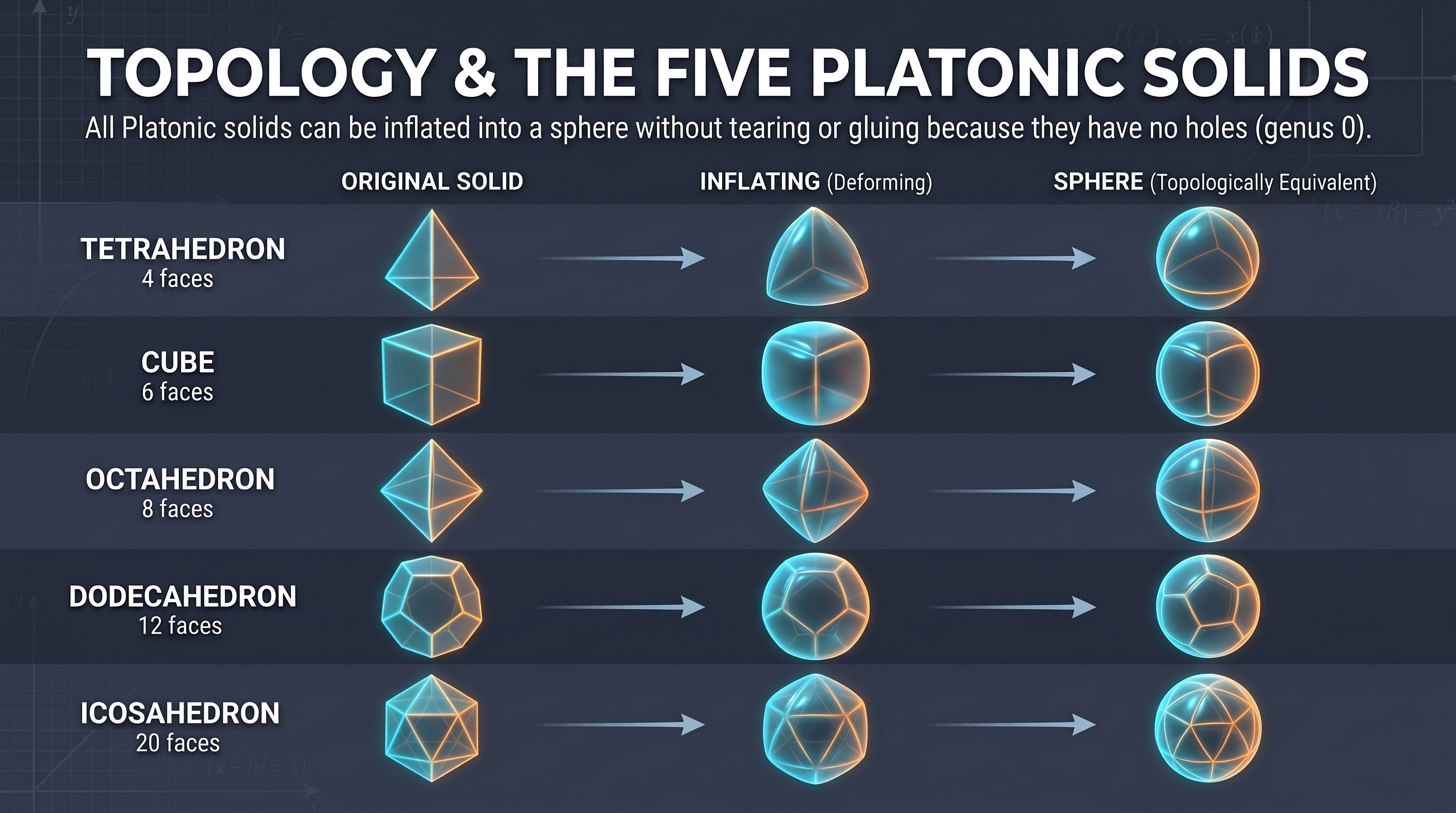
All five Platonic solids can be inflated into a sphere without tearing or gluing. In other words, they have no holes.
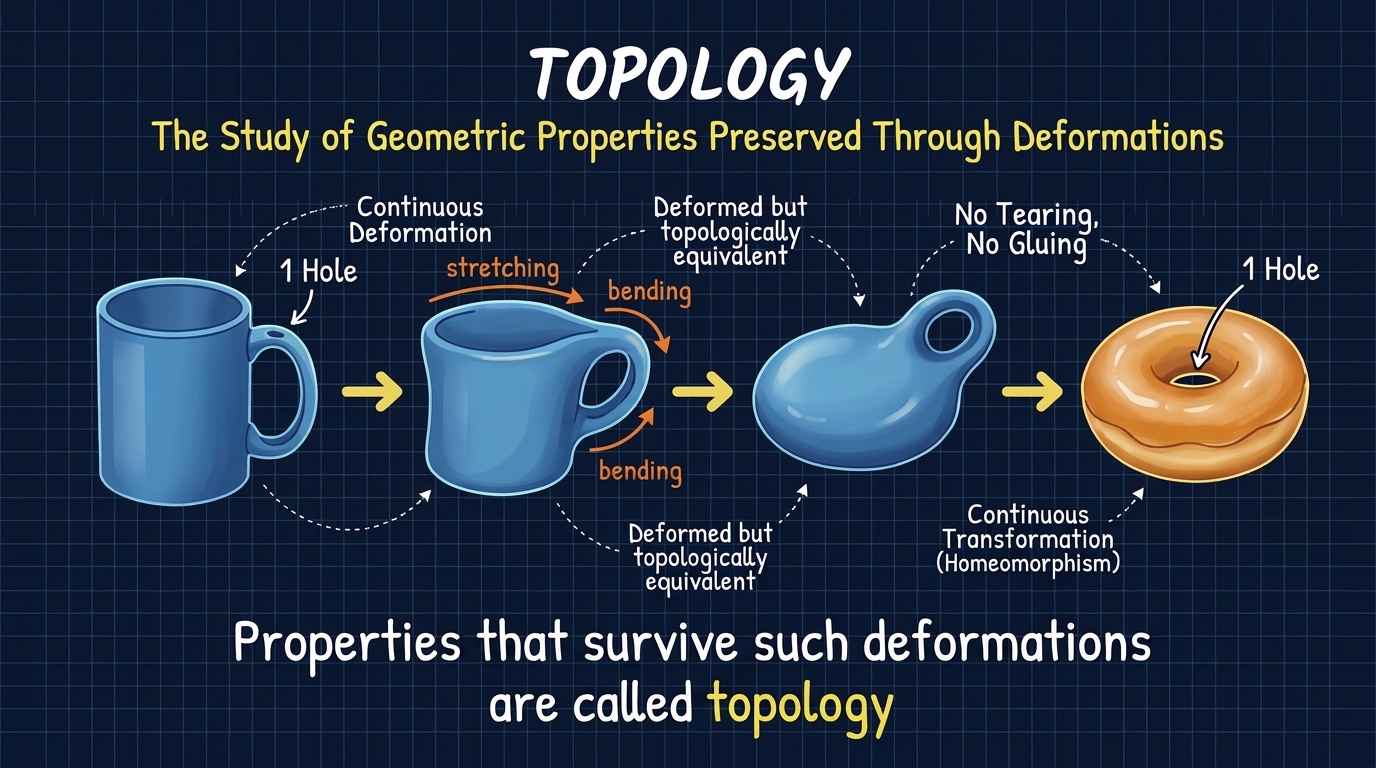
Properties that survive such deformations are called topology.
One topological number does the job here, the Euler characteristic:
| Shape | Corners $V$ | Edges $E$ | Faces $F$ | $\chi = V - E + F$ |
|---|---|---|---|---|
| Tetrahedron | 4 | 6 | 4 | 4 − 6 + 4 = 2 |
| Cube | 8 | 12 | 6 | 8 − 12 + 6 = 2 |
| Octahedron | 6 | 12 | 8 | 6 − 12 + 8 = 2 |
| Dodecahedron | 20 | 30 | 12 | 20 − 30 + 12 = 2 |
| Icosahedron | 12 | 30 | 20 | 12 − 30 + 20 = 2 |
Every sphere-like surface has $\chi = 2$.
The Gauss–Bonnet theorem connects this number to curvature:
In words: cut the surface $M$ into tiny patches of area $dA$, multiply each patch by its Gaussian curvature $K$, and add everything up (that is what the integral sign $\int$ means). The total equals $2\pi$ times the Euler characteristic. For a polyhedron, the curvature sits only at the corners, so the integral turns into the sum of the angle deficits from Section 1.
For anything sphere-like, $\chi = 2$, so the total is $2\pi \times 2 = 4\pi$, or 720°. A smooth sphere spreads this curvature evenly over its whole surface, while a cube packs it into eight corners. The distribution differs, but the total is identical.
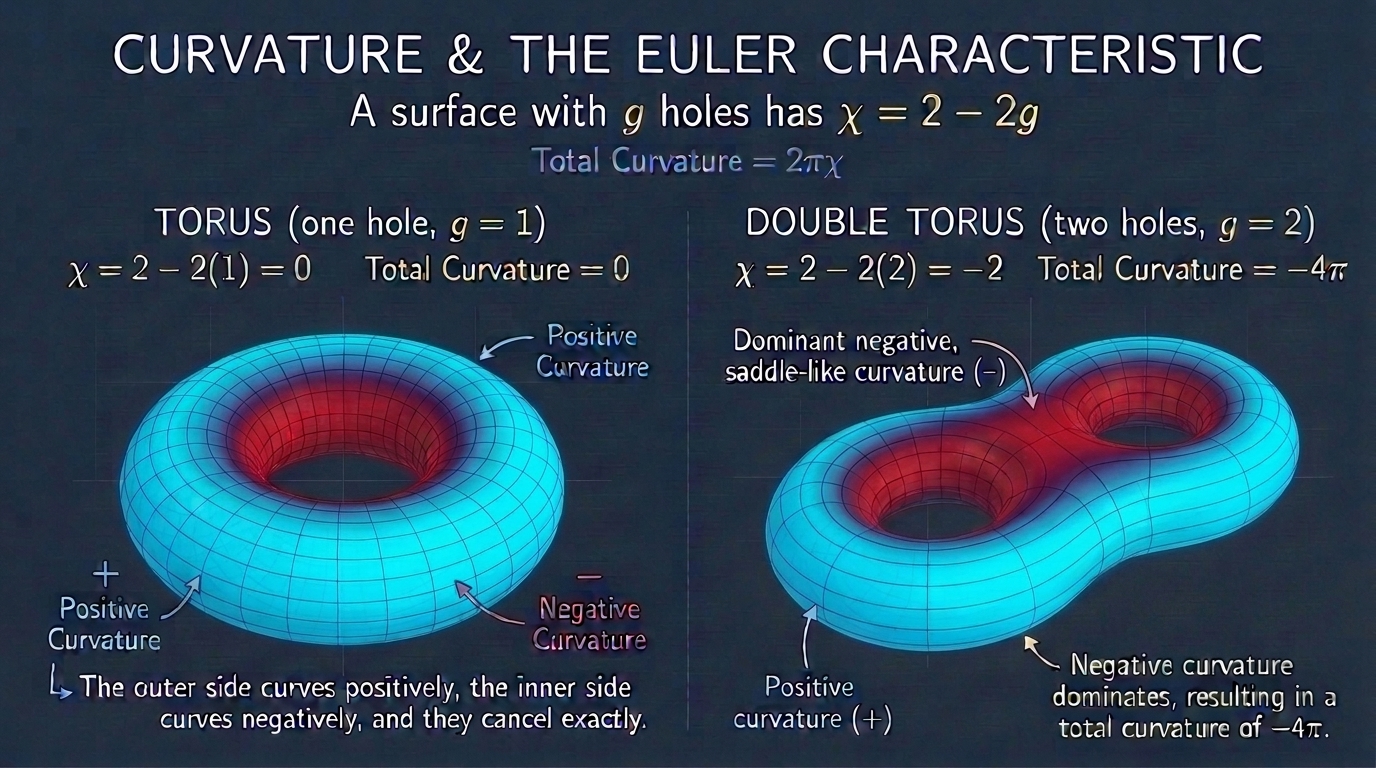
Add holes and the number changes. A surface with $g$ holes has $\chi = 2 - 2g$. A torus (one hole) has $\chi = 0$, so its total curvature is 0: the outer side curves positively, the inner side curves negatively, and they cancel exactly. A surface with two holes has $\chi = -2$ and total curvature $-4\pi$.
The general rule for open surfaces
The formula above is for closed surfaces, which have no edge. Cohn-Vossen extended Gauss–Bonnet to open surfaces such as the catenoid. For a complete surface with finite total curvature and $k$ ends that flare like planes, the total curvature is:
For the catenoid, $\chi = 0$ and $k = 2$, so the total is $2\pi(0 - 2) = -4\pi$. Each plane-like end is a “missing disc” that costs $2\pi$.

5. Takeaway
Curvature answers three different questions: how a surface behaves from the inside ($K$), how it bends in space ($H$), and what overall shape it has (its topology).
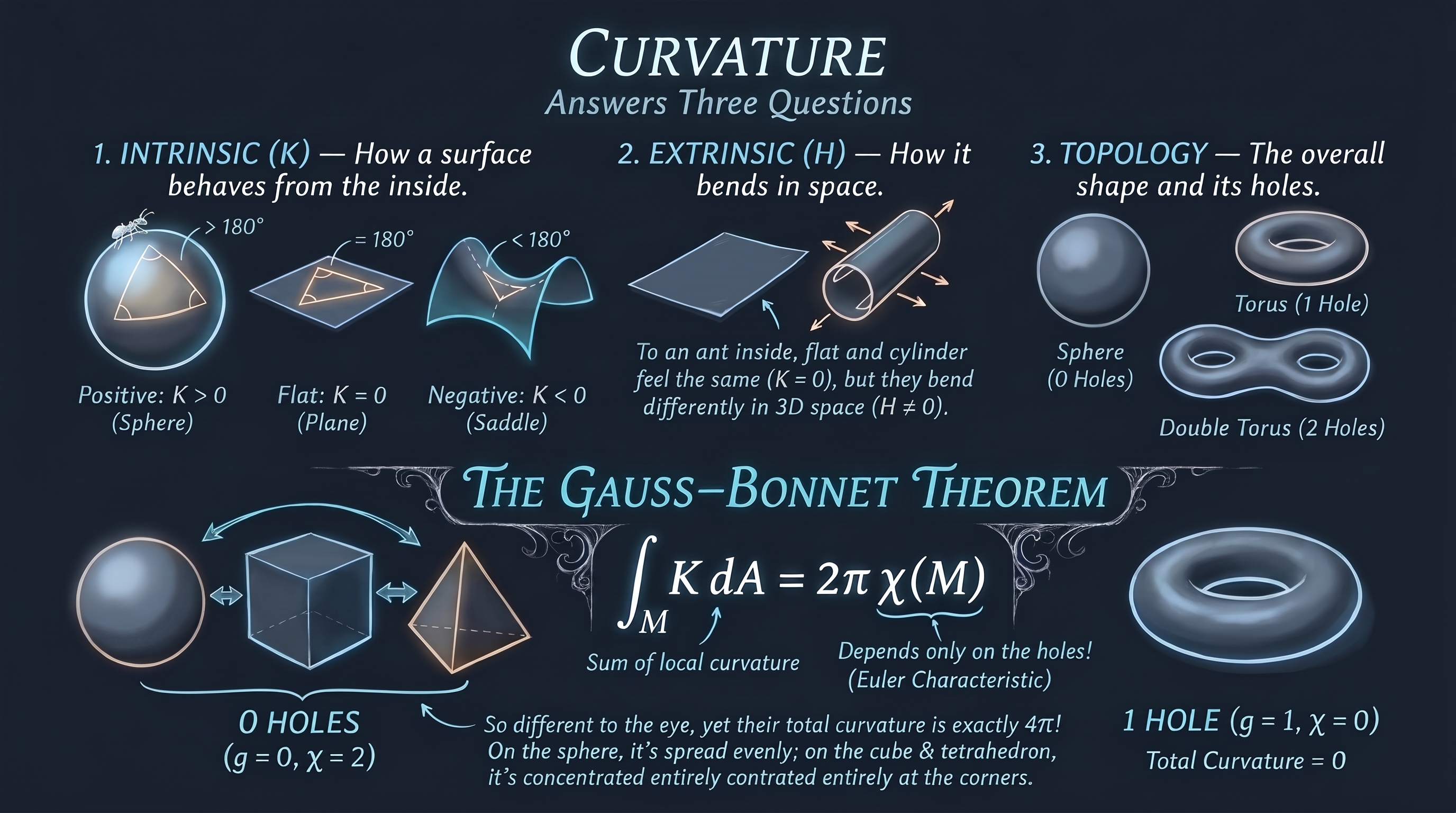
Gauss–Bonnet links the intrinsic Gaussian curvature(K) and the topology: add up the local curvature everywhere, and you get a number that depends only on the holes. That is why a cube, a tetrahedron and a sphere, so different to the eye, share the same total curvature.