Why Calculus Has Only One Theorem
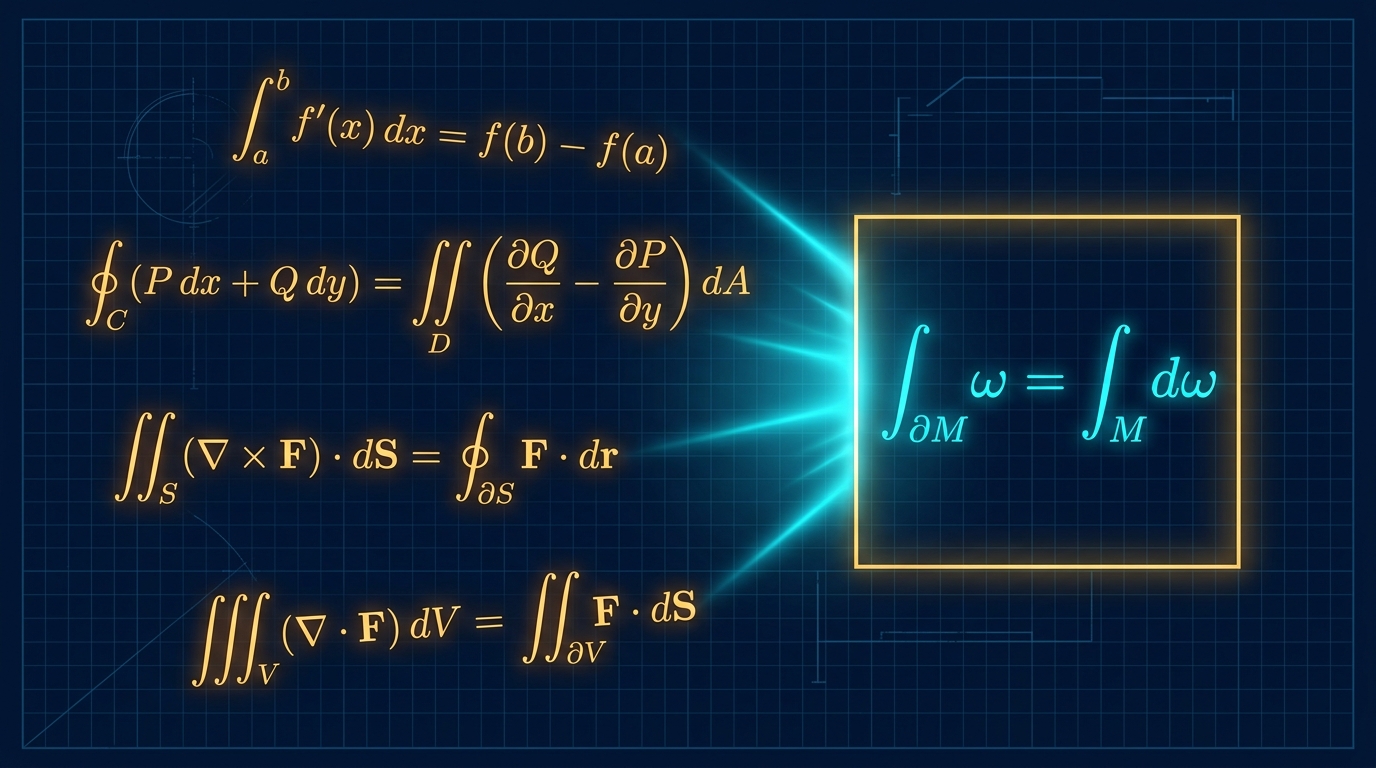
What if gradient, curl, and divergence were not really three different operations? What if the Fundamental Theorem of Calculus, Green's theorem, Stokes' theorem, and the divergence theorem were all the same idea in different dimensions?
By the end of this episode, four famous theorems will become one. The language that makes this possible is called differential forms. The symbols may look intimidating at first, but we'll build the ideas one at a time, starting with a simple question: how do you measure a direction?
1. What Is a Form?
Imagine a tiny measuring device sitting at every point in the plane. You hand it a vector, an arrow showing which way you move and how far. It hands back one number.
Here is the simplest one. Call it $dx$. Feed it a vector $v = (a, b)$, and it returns $a$: the horizontal part. Not a tiny bit of $x$, but a device that reads off the horizontal part of whatever arrow you give it.
Is it a good measuring device? Double the arrow, and the horizontal part doubles:
Add two arrows, $v = (a,b)$ and $w = (c,d)$, and the horizontal parts add:
Those two rules, scaling and adding, are called linearity. Any device that obeys them is a one-form. In the same way, $dy$ returns the vertical part, $dy(a,b) = b$.
Now we can mix them. A general one-form weights each part by a number that can change from point to point, and in three dimensions it adds $dz$ for the depth:
Feed it a velocity vector $\mathbf{v} = (v_x, v_y, v_z)$, and it returns:
It weights each component of the direction by a coefficient and adds the results. Because $P$, $Q$, and $R$ change from point to point, the device varies throughout space.
Now move along a curve $C$. At every tiny step, the one-form measures your direction. Add up all those measurements, and you get a line integral:
That is why one-forms are the natural objects to integrate along curves.
And they are only the beginning. A zero-form is just a function, and you integrate it by evaluating it at points. A one-form is integrated along a curve. A two-form is integrated over a surface. A three-form is integrated over a volume. Differential forms give us one language for integration in every dimension.
2. The Wedge Product
How do we build forms that measure area and volume?
Take two vectors in a plane. They span a parallelogram with an area, and also an orientation, a direction of rotation. Swap the order of the vectors, and the orientation reverses: same area, opposite sign. Make the vectors parallel, and the parallelogram collapses to a line with area zero.
The wedge product, written $\wedge$, captures exactly these properties:
Swap the order, and the sign flips. Repeat a direction, and the result vanishes. These aren't arbitrary algebra rules. They encode the geometry of signed area.
Concretely, $dx \wedge dy$ takes two vectors and returns the signed area of their shadow on the $xy$-plane. With three independent directions, we get an oriented volume element:
3. The Exterior Derivative
Now the operation that ties everything together: the exterior derivative, written $d$. It turns a $k$-form into a $(k+1)$-form.
Apply $d$ to a function $f$, and you get its total differential:
Those coefficients are the components of the gradient.
Apply $d$ to a one-form $\omega = P\,dx + Q\,dy + R\,dz$:
Those three coefficients are the components of the curl.
Apply $d$ to a two-form $\eta = F_1\,dy\wedge dz + F_2\,dz\wedge dx + F_3\,dx\wedge dy$:
That coefficient is the divergence.
So in three-dimensional space, gradient, curl, and divergence are one operation, $d$, acting on zero-forms, one-forms, and two-forms.
Notice that $d$ never used distances, angles, or dot products. It needs no metric. The metric only enters when we translate forms back into arrows and fields.
4. Why $d^2 = 0$
Here is one of the most elegant identities in mathematics:
Apply the exterior derivative twice, and you always get zero. Let's see why for a function. Take $df$ in two dimensions and differentiate again:
The two mixed partial derivatives are equal, and the two wedge terms have opposite signs. They cancel. The same cancellation happens for every form in every dimension.
There is also a geometric echo. Chop a region into tiny squares and trace each one's boundary. Every interior edge is traced twice, in opposite directions, and cancels. Only the outer boundary survives. In short, the boundary of a boundary is empty. The identity $d^2 = 0$ is the algebraic twin of that fact.
It also instantly gives two classical identities: the curl of a gradient is zero, and the divergence of a curl is zero.
5. The Dictionary
Before the main theorem, we need to connect forms to the vector fields you already know. In three-dimensional space, a vector field $\mathbf{F} = (F_1, F_2, F_3)$ can play three roles.
As a one-form, $F_1\,dx + F_2\,dy + F_3\,dz$, it gives the line integral $\mathbf{F}\cdot d\mathbf{r}$.
As a two-form, $F_1\,dy\wedge dz + F_2\,dz\wedge dx + F_3\,dx\wedge dy$, it gives the flux integral $\mathbf{F}\cdot\mathbf{n}\,dS$.
And a function $g$ becomes the three-form $g\,dx\wedge dy\wedge dz$, which gives the volume integral.
6. Generalized Stokes' Theorem
Now the crown jewel. Let $M$ be an oriented region with boundary $\partial M$, and let $\omega$ be a smooth form. Then:
The integral of $\omega$ around the boundary equals the integral of $d\omega$ over the whole region. Why? Chop $M$ into tiny pieces. Interior boundaries cancel in pairs, just as before, so all the tiny changes add up to the net flow along the outer edge.
Now watch what happens as the dimension changes.
One dimension. Let $M$ be the interval from $a$ to $b$. Take $\omega$ to be a function $f$, a zero-form. Then $d\omega = f'(x)\,dx$. The boundary is the two endpoints, with $b$ counted positively and $a$ negatively. That orientation gives:
This is the Fundamental Theorem of Calculus.
Two dimensions, in the plane. Let $M$ be a region $D$ bounded by a curve $C$, and take $\omega = P\,dx + Q\,dy$:
This is Green's theorem.
Two dimensions, in space. Let $M$ be a surface $S$ floating in three-dimensional space, bounded by a loop. Use the one-form version of $\mathbf{F}$ on the left and the two-form $d\omega$, which is the curl, on the right:
This is the classical Stokes' theorem.
Three dimensions. Let $M$ be a solid region $V$ bounded by a closed surface. Use the two-form version of $\mathbf{F}$ on the left, and $d\omega$, which is the divergence, on the right:
This is the divergence theorem.
7. A Worked Example
Let's test it. Take the unit disk $M$ and the one-form $\omega = -y\,dx + x\,dy$.
First, the boundary. The boundary is the unit circle, so set $x = \cos t$ and $y = \sin t$ for $t$ from $0$ to $2\pi$. Then $dx = -\sin t\,dt$ and $dy = \cos t\,dt$, and the form becomes:
So the boundary integral is:
Now the interior. The exterior derivative is:
That's a constant density of $2$ over the disk. The disk has area $\pi$, so the integral is $2\pi$.
Both sides give the same number: $2\pi$.
Why It Matters
Why switch to forms when vector calculus already works? Because vector calculus is tied to three-dimensional flat space, and forms are not. They work on curved manifolds, in spacetime, and in any dimension, with no new rules.
Even a swirling fluid shows this. Describe the velocity of a flow as a one-form, $u$. Its exterior derivative, $du$, is the vorticity: the local spin of the fluid.
Stokes' theorem now says something physical. The circulation of the fluid around a closed loop, $\oint_{\partial S} u$, equals the total vorticity passing through any surface $S$ the loop encloses, $\iint_S du$. Circulation on the boundary is vorticity in the interior. This is the starting point for Kelvin's circulation theorem, which says that in an ideal fluid, the circulation around a loop carried along with the flow does not change.
And $d^2 = 0$ gives a second fact for free. Apply $d$ to the vorticity, and $d(du) = 0$. The vorticity field has no divergence, which means vortex lines can never begin or end in the middle of the fluid. They must close into loops or run to the boundary. That is why smoke rings hold together as they travel.
No messy vector identities were needed, just Stokes' theorem and $d^2 = 0$, the two ideas we have used so far in this episode.