Christoffel Symbols: How the Basis Changes
1. The Problem: You Cannot Subtract Vectors at Different Points
At the end of Foundations 3, we saw that $T_pM$ and $T_qM$ are different spaces. Now try to differentiate a vector field $Y$ the usual way, along a curve $\gamma$ through $p$:
The numerator subtracts a vector in $T_{\gamma(h)}M$ from a vector in $T_pM$. That subtraction is not defined, so the limit has no meaning yet. We need a rule that tells us how to compare vectors at nearby points.
2. Two Things Can Change
Write the vector field in components, $Y = Y^i\partial_i$. As we move from point to point, two different things can change:
- the components $Y^i$, which are ordinary functions, and
- the basis vectors $\partial_i$ themselves.
Whether we can ignore the second one depends on the coordinates. Let’s look at an easy case first, and then a hard one.
3. The Easy Case: Cartesian Coordinates
In Cartesian coordinates on the flat plane, $\partial_x$ and $\partial_y$ are the same at every point. Only the components can change, so differentiating a vector field just means differentiating its components.
For example, take $Y = x\,\partial_y$, whose components are $Y^x = 0$ and $Y^y = x$. Moving in the $x$ direction:
Ordinary calculus is enough.
4. The Hard Case: Polar Coordinates
Now use polar coordinates on the same plane. Take the constant field $Y = \partial_x$. It points the same way everywhere, so its derivative should be zero. Written in the polar basis, it is:
The components $Y^r = \cos\theta$ and $Y^\theta = -\sin\theta/r$ are not constant, even though the vector field is. If we differentiated only the components, we would get a nonzero answer for a field that is not changing at all.
The reason is that the basis vectors $\partial_r$ and $\partial_\theta$ turn and stretch as we move. The components change to compensate, and we have to account for the basis changing too.
5. The Fix: Differentiate the Basis Too
So a correct derivative has two parts. Write $\nabla_j$ for the derivative in the direction $\partial_j$ that we are trying to define, and use the product rule:
The first term is the change of the components. The second term is the change of the basis. In Cartesian coordinates, the second term is zero. In polar coordinates, it is exactly what cancels the unwanted change in the components above.
Everything now depends on one question: how does a basis vector change as we move? The Christoffel symbols answer it.
6. Defining the Christoffel Symbols
The derivative of a basis vector is again a vector, so we can expand it in the basis. The coefficients are the Christoffel symbols:
Read the indices this way: $j$ is the direction we move in, $i$ says which basis vector we are differentiating, and $k$ says which basis vector we express the result in. Substituting into the product rule and relabeling the dummy indices gives:
The first term is the change of the components. The second term is the change of the basis.
Detailed Steps: From the Definition to the Covariant Derivative
We derive $\nabla_j Y^k = \partial_j Y^k + \Gamma^k_{ji}\,Y^i$ from the definition of the Christoffel symbols and the product rule, with every index made explicit.
Step 0. Setup. Use coordinates $x^i$ with the coordinate basis $\partial_i = \partial/\partial x^i$. Write the vector field as $Y = Y^i\partial_i$ (summed over $i$), where the components $Y^i(x)$ are functions of position. The symbol $\nabla_j \equiv \nabla_{\partial_j}$ is the covariant derivative in the direction of the $j$-th coordinate, and $\partial_j$ is the ordinary partial derivative.
Step 1. Apply $\nabla_j$ to the vector field.
Here $Y^i$ is a scalar function and $\partial_i$ is a basis vector, so this is a scalar times a vector. The product rule from §5 gives:
Term 1 differentiates the scalar factor $Y^i$. Term 2 differentiates the vector factor $\partial_i$.
Step 2. Term 1: the scalar derivative. $Y^i$ is a single number at each point, with no basis attached, so its derivative is the ordinary partial derivative $\partial_j Y^i$. That is why Term 1 is $(\partial_j Y^i)\,\partial_i$.
Step 3. Term 2: insert the Christoffel definition. The derivative of a basis vector is again a vector, so it can be expanded in the basis. That is the definition of the Christoffel symbols:
Here $j$ is the direction of differentiation, $i$ is the basis vector being differentiated, and $k$ is the basis vector in which the result is expressed (summed over $k$). Substituting into Term 2:
Step 4. Combine both terms.
Term 1 carries $\partial_i$, while Term 2 carries $\partial_k$. To read off components, we need the same basis vector in both.
Step 5. Relabel the dummy index in Term 1. In Term 1, $i$ is a summed index, so we can rename it $k$ without changing the value:
It is a pure relabeling, since $i$ and $k$ both run from $1$ to $n$.
Step 6. Factor out the common basis vector.
Step 7. Read off the components. The components of $\nabla_j Y$ are the coefficients of $\partial_k$:
A note on notation: here $\nabla_j Y^k$ means the $k$-th component of the vector $\nabla_j Y$, not the derivative of the scalar function $Y^k$. This shorthand is standard, but easy to misread.
7. A Worked Example: Polar Coordinates
In the flat plane, we can compute the symbols by a shortcut: Cartesian basis vectors are constant, so we can express the polar basis in Cartesian terms and differentiate. First, the polar basis:
Now differentiate each one:
Reading off the coefficients:
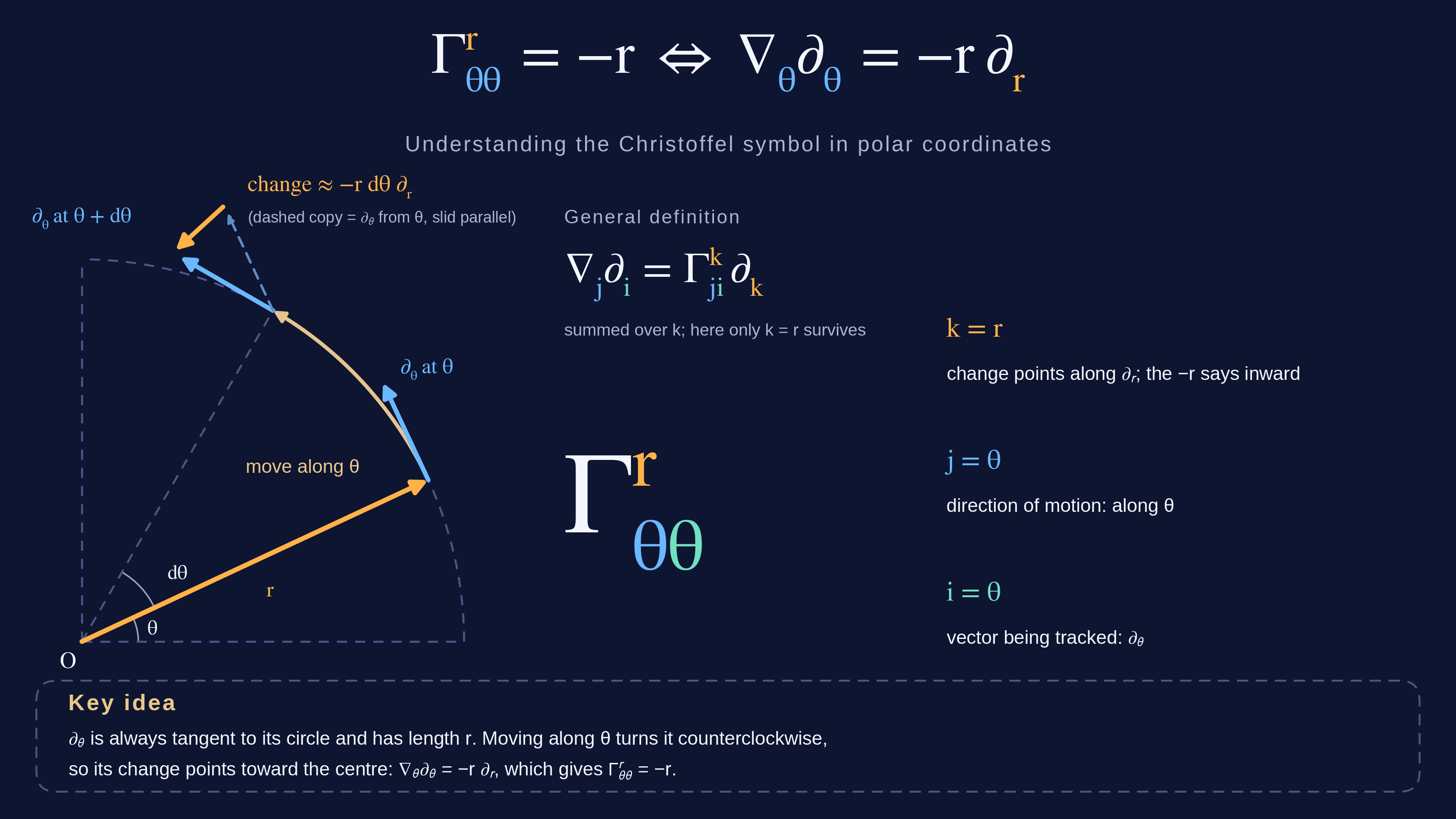
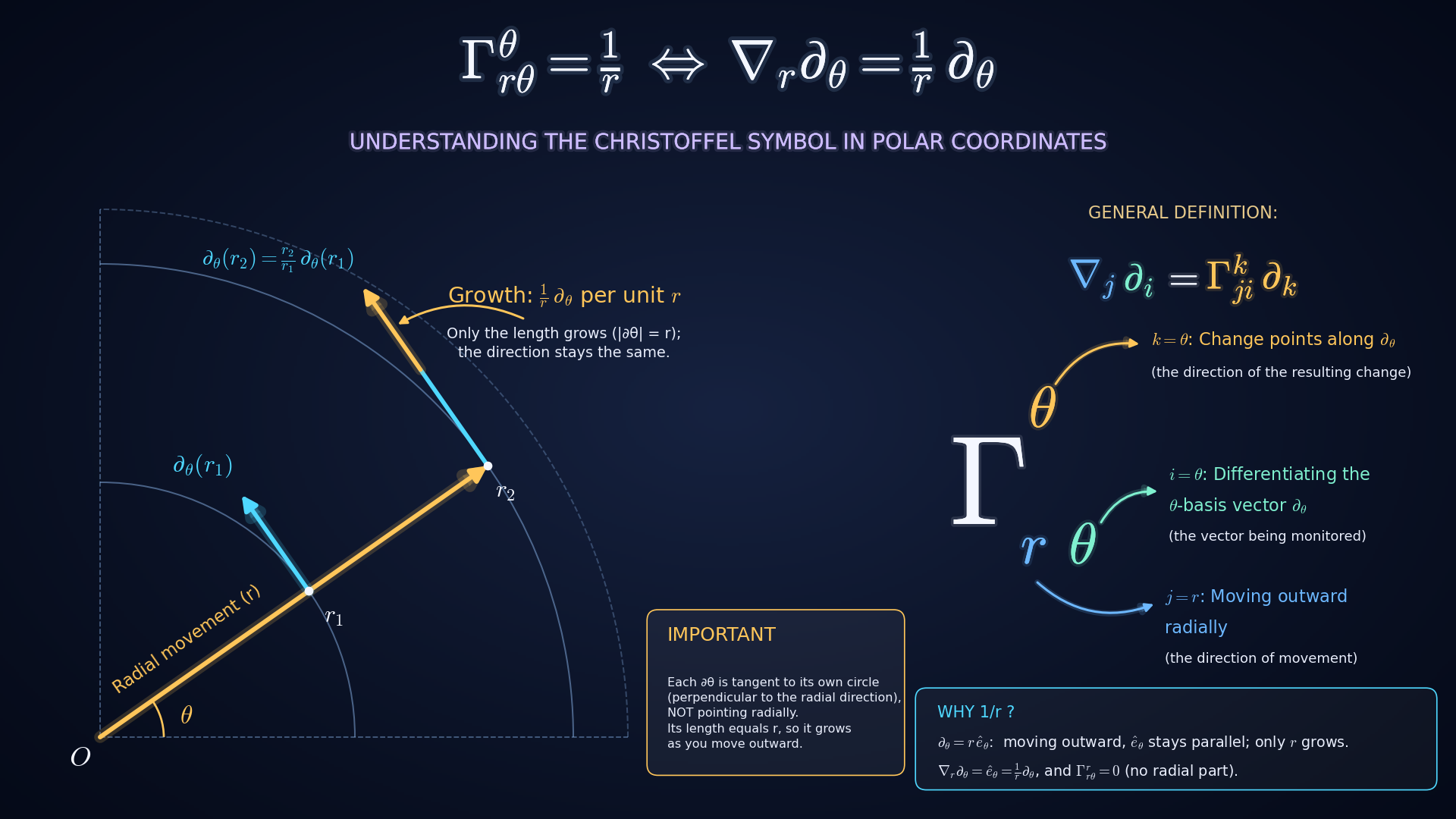
The two nonzero values have a clear meaning:
- $\Gamma^\theta_{r\theta}=1/r$: as you move outward, $\partial_\theta$ gets longer (its length is $r$), at the relative rate $1/r$.
- $\Gamma^r_{\theta\theta}=-r$: as you move around the circle, $\partial_\theta$ turns toward the origin. That is the $-r\,\partial_r$.
As a test, return to the constant field $Y=\partial_x = \cos\theta\,\partial_r - \frac{\sin\theta}{r}\,\partial_\theta$, whose derivative must be zero. Differentiate in the direction $\partial_\theta$, using the rule from §6 and the symbols above:
The change of the components and the change of the basis cancel exactly, as they should.
The Cartesian shortcut works only in flat space. In a curved space, there is no such shortcut, and the symbols must come from somewhere else.
8. Where Do They Come From?
A rule for comparing nearby vectors, called a connection, is extra structure, and in general it is a choice. But when we ask that it preserve lengths and angles, and not twist, the metric determines it completely:
Part 5 of From Euclid to Riemann develops this in detail. As a check, use the polar metric $g_{rr}=1$, $g_{\theta\theta}=r^2$:
Both agree with the shortcut above.
9. Christoffel Symbols Are Not a Tensor
On the flat plane, every $\Gamma^k_{ij}$ is zero in Cartesian coordinates, but not in polar coordinates. A tensor that is zero in one coordinate system is zero in every other, because changing coordinates only multiplies components by Jacobians. So the Christoffel symbols cannot be a tensor. Their transformation law has an extra term:
The second term, with second derivatives of the coordinate change, is the culprit. It is also exactly what repairs the covariant derivative: $\partial_j Y^k$ alone does not transform like a tensor, but the $\Gamma$ term cancels the misbehavior, so $\nabla_j Y^k$ does.
Notice that $\Gamma^k_{ij}$ has one upper and two lower indices, just like a tensor would, yet it does not behave like one. In the next episode, we define precisely what a tensor is.
10. Looking Ahead
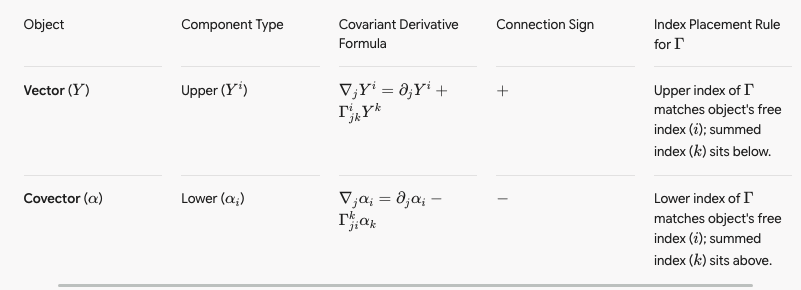
For covectors, the sign flips, so that the pairing $\alpha_i Y^i$ still obeys the ordinary product rule:
The same symbols also lead to two ideas that come next in the main series. A vector field is called parallel along a curve when $\nabla Y = 0$ along it, which gives parallel transport. And in flat space there are coordinates in which every $\Gamma$ vanishes, while in a curved space you can make them vanish at a single point but never on a whole neighborhood. That obstruction is curvature.