Logarithmic World, Linear Mind
Take a big pile of real-world numbers: river basin areas, stock prices, city populations, electricity bills.
You might expect the first digit of each number to be a roll of the dice, with an equal chance of anything from 1 to 9.
But in many datasets, nearly a third of the numbers start with 1.
1. The dirty pages
In 1881, the American astronomer Simon Newcomb was working with a book of logarithm tables. Before electronic calculators, these printed tables were how people handled hard calculations. And he noticed something odd.

The pages near the front, covering numbers that begin with 1, were dirty and frayed. The pages near the back, covering 8s and 9s, were much cleaner.
People were looking up numbers beginning with 1 far more often. Newcomb suspected the reason: numbers in the real world simply tend to begin with 1. He worked out a logarithmic rule and published it in the American Journal of Mathematics. Almost nobody noticed.
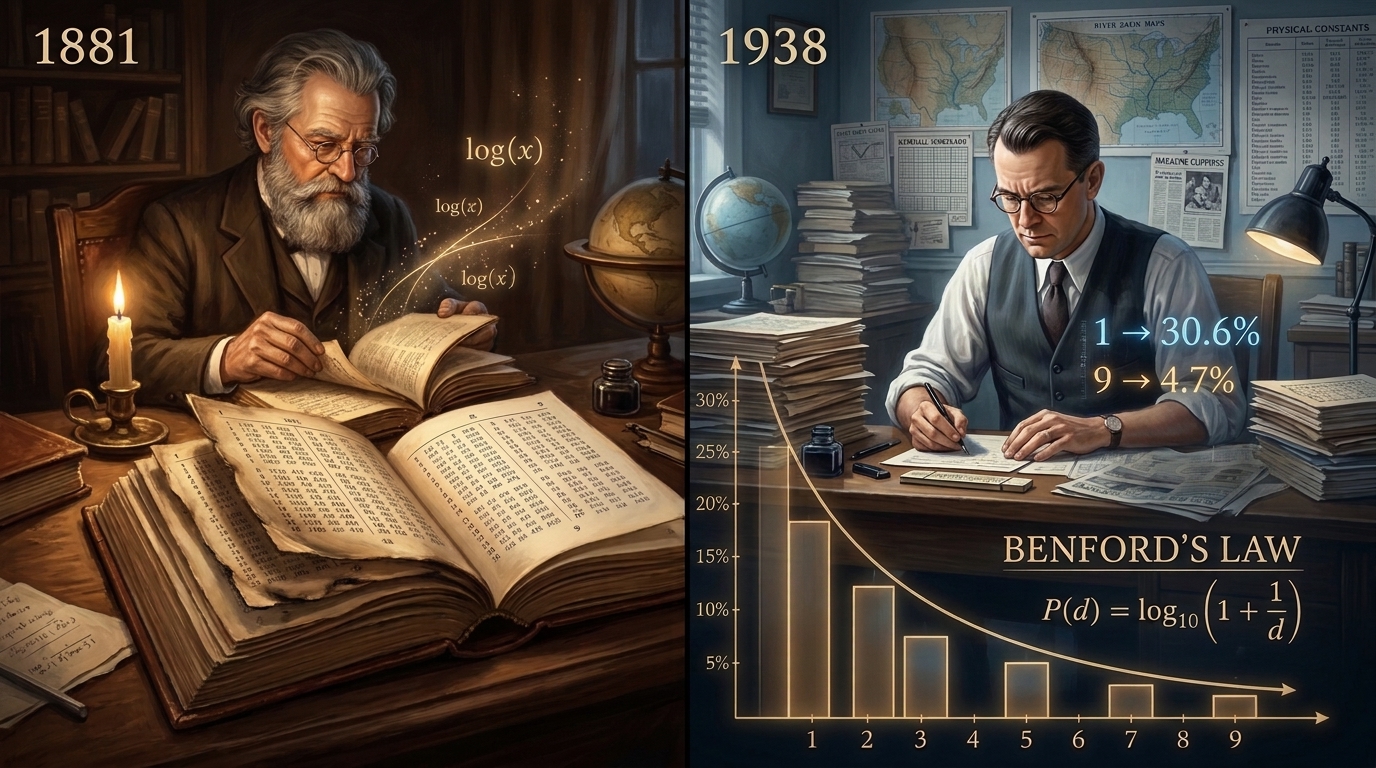
Nearly six decades later, in 1938, the physicist Frank Benford independently found the same pattern, and this time he tested it at scale. He gathered more than twenty thousand observations, from river basin areas and baseball statistics to physical constants, magazine articles, and death rates.
About 30.6 percent began with the digit 1. Only about 4.7 percent began with 9.
The pattern follows a simple formula, shown below, which predicts about 30.1 percent for 1 and 4.6 percent for 9.
Here $d$ is the first digit, from 1 through 9.
It became known as Benford’s law, even though Newcomb got there first. Which is typical: scientific discoveries are rarely named after the person who found them first.
So why does the digit 1 keep winning?
2. Why the digit 1 keeps winning
Think about a quantity that grows by a constant percentage, like a bank balance earning 7 percent a year.
Going from 1,000 to 2,000 takes about ten years. Going from 8,000 to 9,000 takes less than two.
The balance lingers among the 1s and rushes through the 9s. Climbing from 1 to 2 means growing by 100 percent, while climbing from 8 to 9 takes only 12.5.
That hints that the natural scale for such data is not linear but logarithmic.
On a logarithmic ruler, every power of ten gets the same amount of space. The stretch from 1 to 2 fills about 30 percent of it, while the stretch from 9 to 10 fills under 5 percent.
If values are spread roughly evenly along that ruler, the digit 1 will appear far more often than 9. That is exactly what Benford’s formula describes.
3. A deeper clue: changing units
There is a second clue. Convert dollars to euros, or meters to feet. The numbers change, but the things being measured do not.
So a pattern that is a real property of the data should survive a change of units.
To see why, we need one fact: a number’s first digit depends only on where it sits within its decade (1 to 10, 10 to 100, and so on), not on its size. The numbers 1.5, 15, and 150 all sit at the same spot in their decades, and all start with 1.
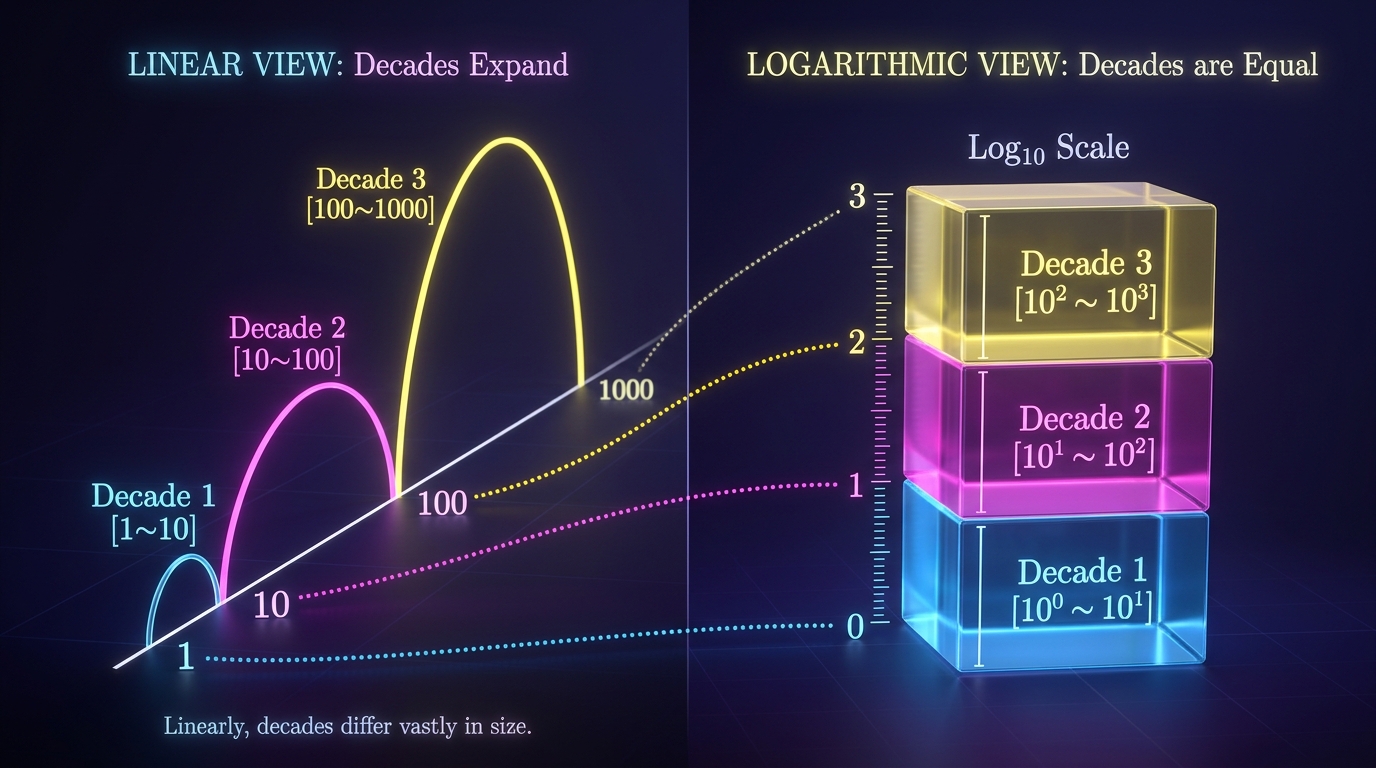
On a logarithmic scale, every decade becomes a segment of equal length, and a number’s spot within its decade is simply the part of its logarithm after the decimal point.

Now change the units. That means multiplying every number by the same constant $c$. On a logarithmic scale, multiplication becomes addition, so the whole dataset slides the same distance along the axis.
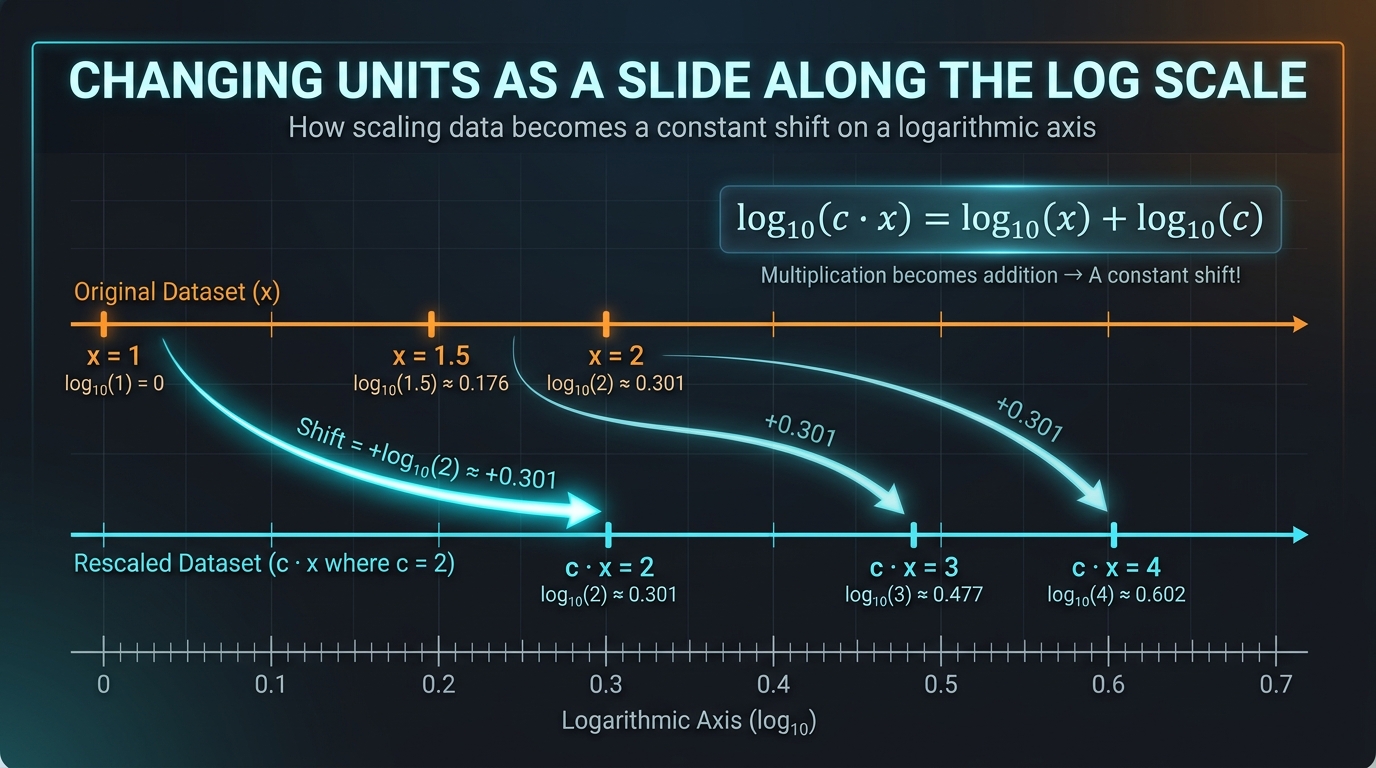
If the slide runs past the end of a decade, the number wraps around to the start, like a clock: 11 o’clock plus two hours is 1 o’clock.
Suppose the data is spread evenly around that clock. Rotating an evenly spread clock changes nothing, so the share of numbers starting with 1 stays at 30.1 percent after any change of units.
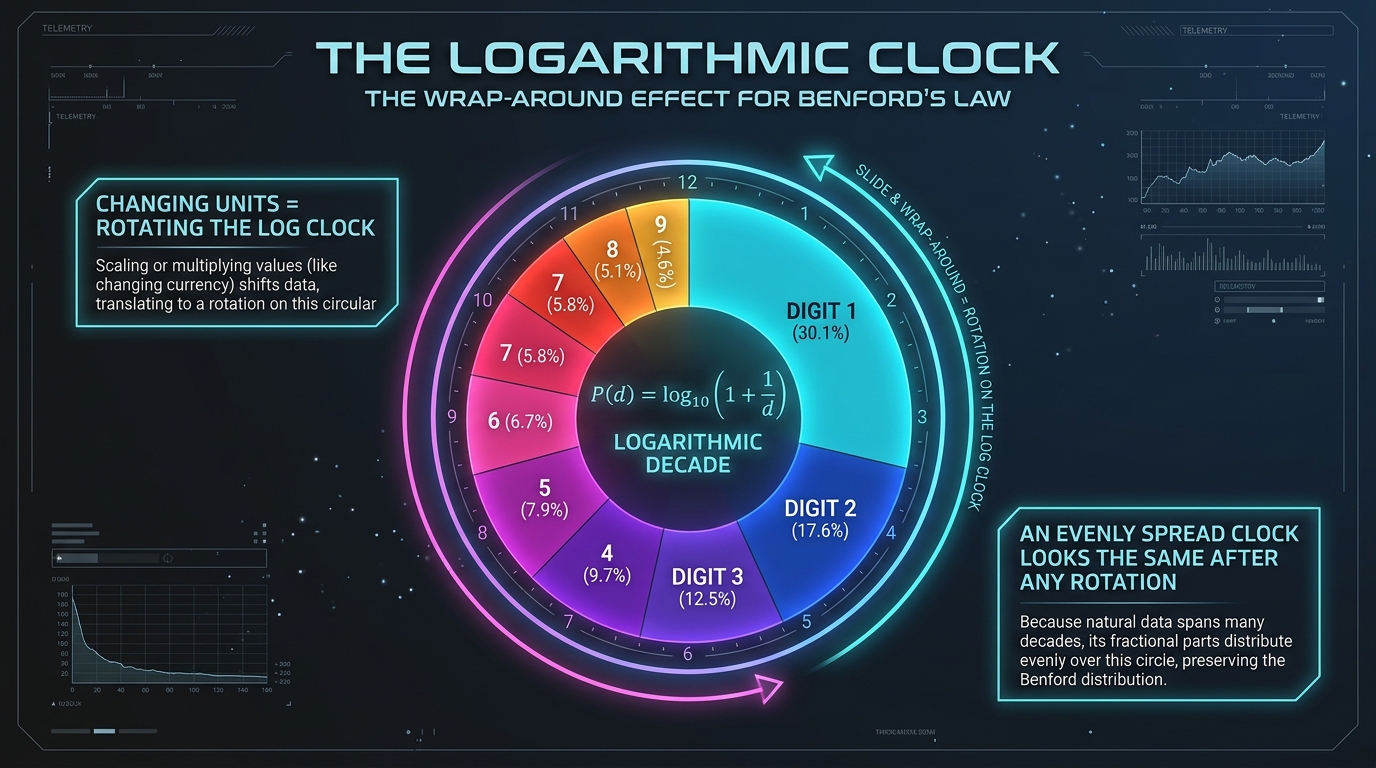
In fact, mathematicians later proved that this works in reverse: if you demand that a first-digit pattern survive any change of units, Benford’s law is essentially the only possible answer.
But why should real data be spread evenly on a logarithmic scale in the first place?
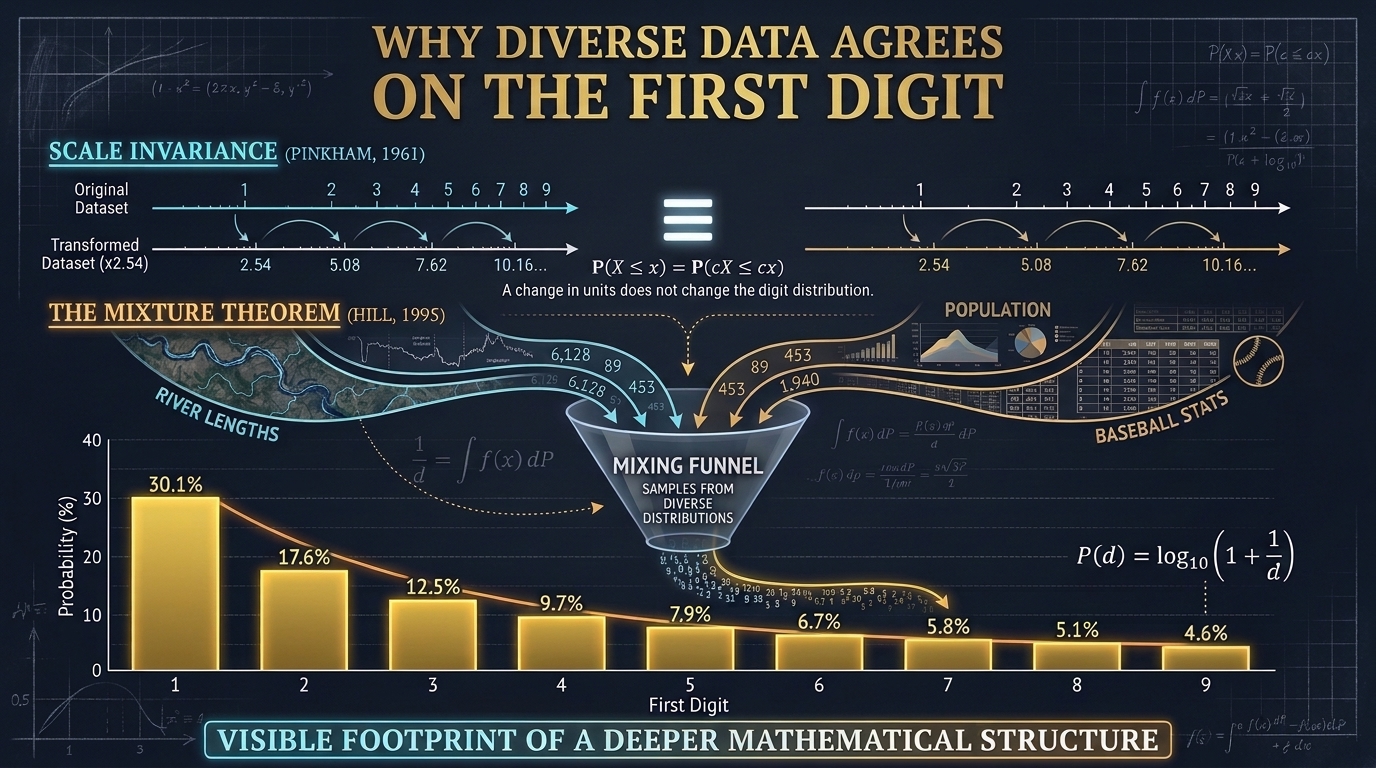
The answer lies in how data accumulates: when you mix numbers originating from many different processes and sources, the combined dataset is naturally pushed toward Benford’s law. Rivers, populations, and baseball statistics all behave like such mixtures.
So the digit 1 is not being favored by nature. It is the visible footprint of a deeper mathematical structure.
4. From nature to forensic accounting
What happens when the numbers come not from nature, but from people?
In the 1990s, mathematician Mark Nigrini helped turn Benford’s law into a practical tool. If a ledger should follow the law, a large deviation is a warning sign worth checking.
Take a real case. In 1993, a manager in the Arizona State Treasurer’s office was found guilty of trying to defraud the state of nearly two million dollars through 23 checks to a bogus vendor.
More than 90 percent of the check amounts began with 7, 8, or 9, almost the opposite of Benford’s pattern. The amounts also stayed just below a likely extra-approval threshold, and none was round or repeated.
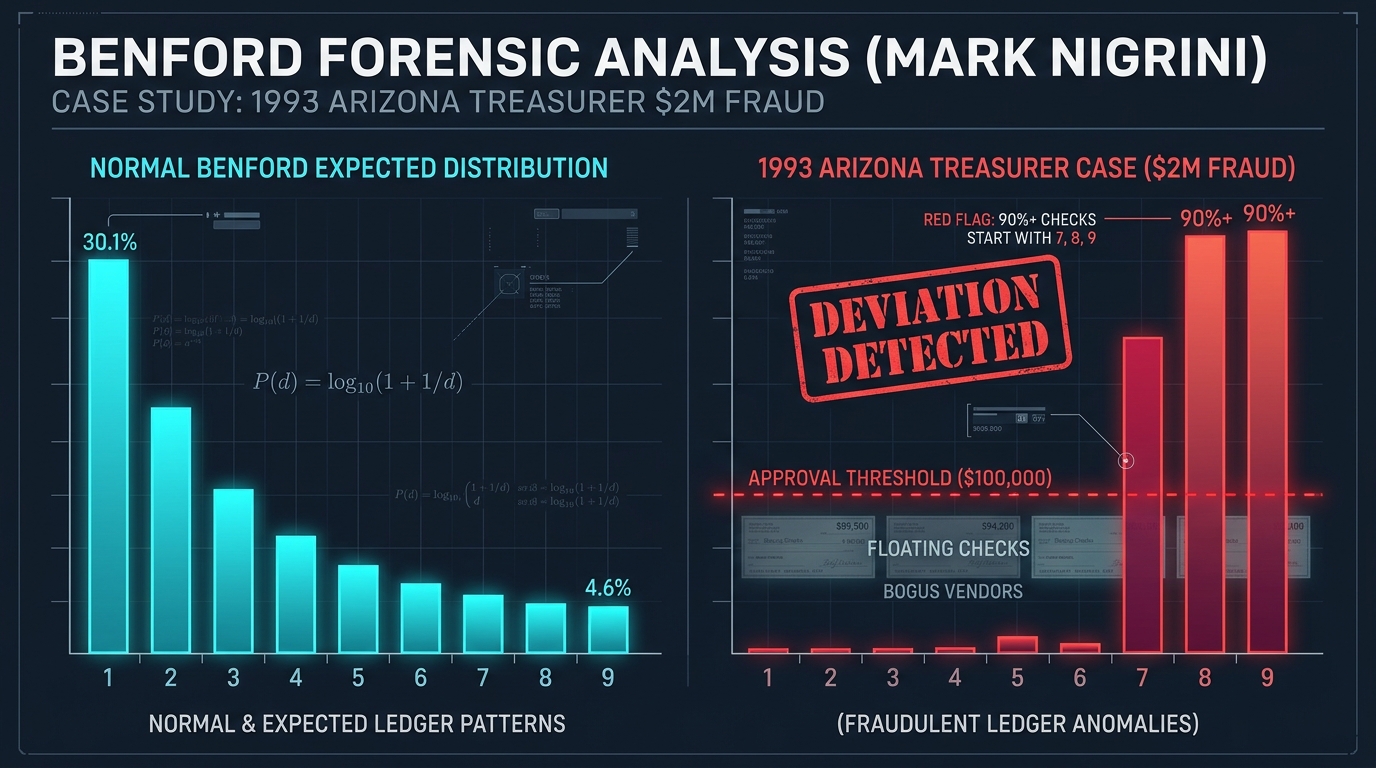
People inventing numbers rarely know about Benford’s law. They spread digits too evenly, or they bunch amounts just under an approval limit. Investigators can also look beyond the first digit, at the second digit or the first two digits together.
5. Caveats
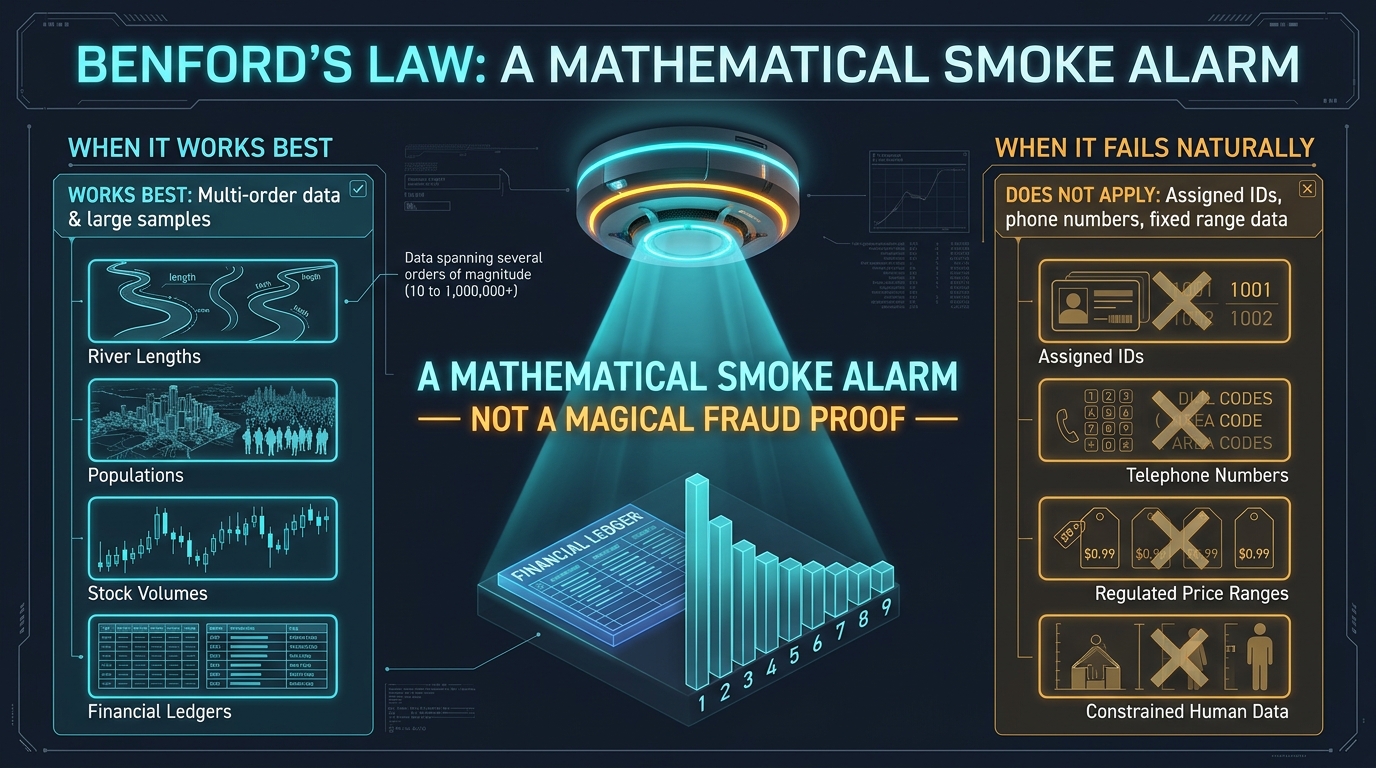
A deviation from Benford’s law does not prove fraud, and not every dataset should follow it.
It works best for naturally occurring numbers that span several orders of magnitude, in reasonably large samples. Telephone numbers, assigned ID numbers, and prices held in a narrow range may not follow it at all, and neither does data with a built-in minimum or maximum.
So Benford’s law is not a magical fraud detector. It is a mathematical smoke alarm. It tells investigators: something here deserves a closer look.
Conclusion: the story comes full circle
Go back to Newcomb and those frayed pages. They were worn because the world kept asking for 1s.
Numbers that span many scales are often better understood in logarithmic space. And when people invent numbers, they can leave traces that don’t match that hidden structure.
That makes Benford’s law a meeting point of mathematics, nature, and human behavior.