What Is a Tensor? Index Position Determines Transformation
1. From Separate Indices to One Language
So far, we have examined superscripts and subscripts separately. Superscripts ($x^i$, $v^i$) label the components of contravariant vectors, while subscripts ($x_i$, $\alpha_i$) label the components of covariant vectors, or covectors.
Now it is time to unite both under a single mathematical language. That language is the tensor.
2. What Is a Tensor?
Let us begin with the simplest definition. A tensor is a multilinear function that takes several vectors and covectors as inputs and outputs a single number.
“Multilinear” means that it is linear in each input separately. Double one input, and the output doubles. Add two vectors in one slot, and the outputs add:
But this definition alone misses the point. The true essence is the following:
One distinction matters here. When we write $T^{ij}$, we mean the components of the tensor in a chosen coordinate system, not the tensor itself. The tensor is the coordinate-free object. The components are only its description.
3. Index Position Determines Transformation
When the coordinates change, the components of a tensor change too. But not all components change in the same way:
- An upper index means the component transforms contravariantly. If the basis vectors scale up, the component scales down.
- A lower index means the component transforms covariantly. If the basis vectors scale up, the component scales up with them.
Index position also tells us the input type. A lower index marks a slot that accepts a vector. An upper index marks a slot that accepts a covector. That is why the components of a vector carry an upper index: a vector can be seen as something that takes a covector and returns a number.
A tensor applies these rules to every index at once. Some examples:
- $T^i$: the components of a vector
- $T_i$: the components of a covector
- $T^{ij}$: two upper indices
- $T_{ij}$: two lower indices
- $T^i{}_j$: a mixed tensor, with one upper and one lower index
The transformation laws for a vector, a covector, and the metric show the pattern:
Each upper index picks up one factor of $\partial\tilde x/\partial x$. Each lower index picks up one factor going the other way, $\partial x/\partial\tilde x$.
4. A Word of Caution: Indices Alone Do Not Make a Tensor
Simply writing indices up or down does not make an object a tensor. What matters is whether its components actually follow these laws.
The Christoffel symbols from Foundations 5 carry both upper and lower indices, yet they are not a tensor. Neither is the plain derivative of a vector’s components. Under a change of coordinates, the chain rule produces an extra term:
The first term transforms like a tensor. The second, with its second derivatives of the coordinate change, spoils the law. That extra term is exactly what the Christoffel symbols repair in the covariant derivative.
So index placement is not a notational habit. It is a convention that promises a transformation property, and the promise has to be kept.
Genuine tensors are all around us: the stress tensor in engineering, the inertia tensor in mechanics, and the Kronecker delta $\delta^i{}_j$, a mixed tensor whose components look identical in every coordinate system.
5. Why Must Transformation Be This Complex?
The reason is simple. Even when the components change, the geometric object they describe must not.
Consider a vector drawn as an arrow. It must be the same physical arrow no matter how you draw the axes. Switch from meters to centimeters, and the number changes, but the length does not. Coordinate changes are far more general than unit conversions, but the principle holds: the components and the real object are different things.
The same applies to a covector. It takes a vector and returns a number, and that number cannot depend on the coordinates we chose.
A tensor extends this principle to many inputs. So there is only one reason tensor components follow different laws depending on index position:
6. The Most Important Example: The Metric Tensor
One of the most fundamental tensors in Riemannian geometry is the metric tensor $g_{ij}$. It takes two vectors and returns their inner product, and from it we get lengths and angles:
It carries two lower indices because it has two slots that accept vectors.
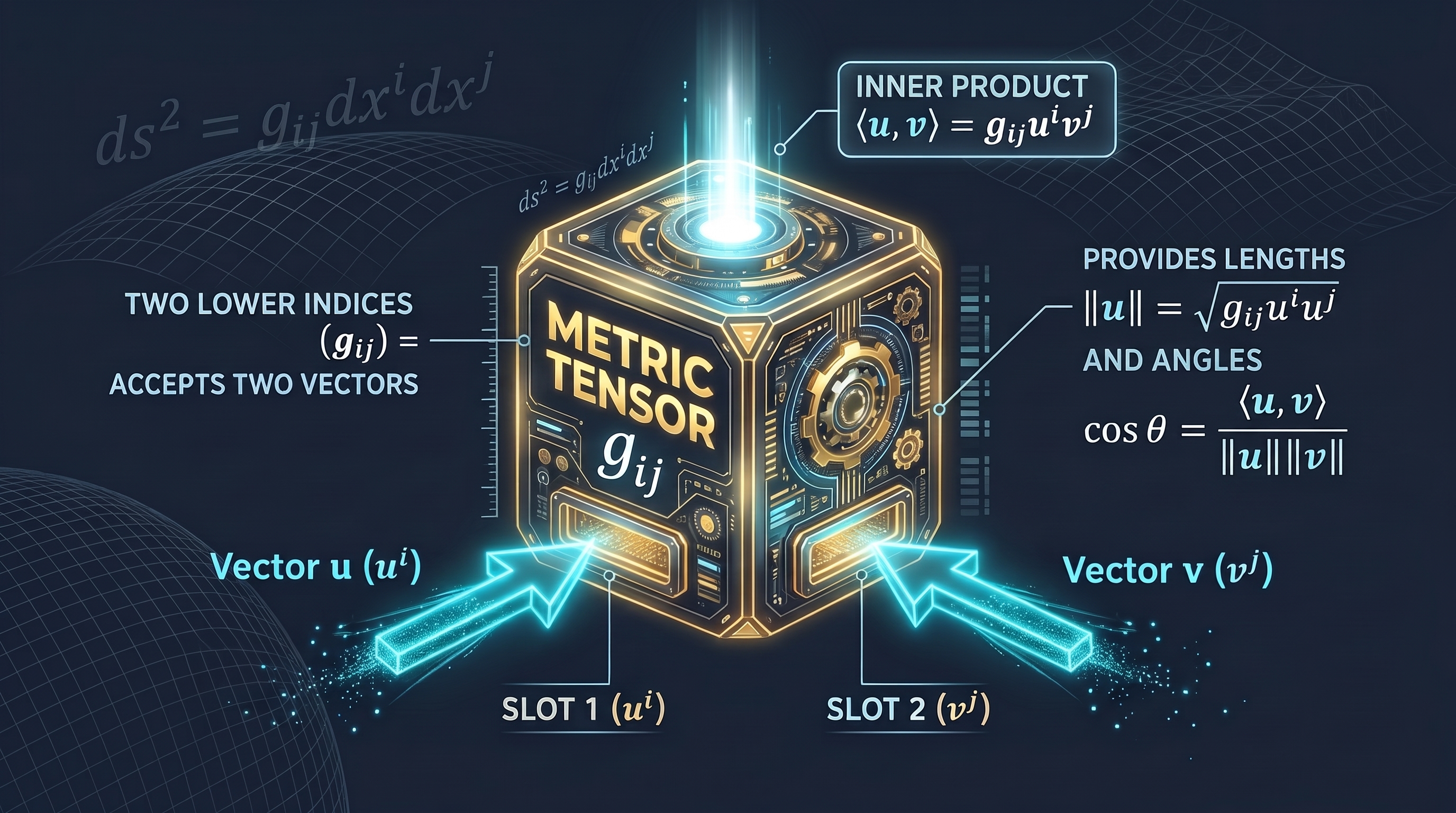
Why is the result independent of the coordinates? Check how each piece transforms. The two vectors carry upper indices, and the metric carries two lower ones, so their transformation factors cancel, using the chain-rule identity $\dfrac{\partial x^k}{\partial\tilde x^i}\dfrac{\partial\tilde x^i}{\partial x^m}=\delta^k_m$:
A Numerical Check
Take the coordinate-halving example from Part 4 of From Euclid to Riemann: $\tilde x = x/2$. In one dimension, the components of each vector halve. The metric component, with its two lower indices, picks up a factor of two twice, so it quadruples:
The factors cancel, and the inner product is unchanged. The individual numbers inside change, but the geometric value does not.
The metric does one more job we saw earlier: with its inverse, it converts $T^i$ into $T_i$ and back. That is the same index-position logic at work. This is the true power of tensors.
7. Summary
The most practical way to hold the idea of a tensor is to keep three points in mind:
- The number of indices tells you how many inputs the tensor takes.
- The position of each index tells you the input type, and how that component transforms.
- The transformation laws guarantee that geometric meaning survives a change of coordinates.
| Index | Slot accepts | Component transforms | Factor per index | Example |
|---|---|---|---|---|
| Upper | covector | contravariantly | $\partial\tilde x/\partial x$ | $v^i$ |
| Lower | vector | covariantly | $\partial x/\partial\tilde x$ | $\alpha_i,\; g_{ij}$ |
Superscripts and subscripts are not stylistic habits. They are a signature.
8. Looking Ahead
Tensors let us express geometric quantities like length and angle in curved space. But how do we compare two vectors located at different points? And, as we just saw, the ordinary derivative of a vector fails to be a tensor. In flat space, we can simply slide a vector along. In curved space, we need a new foundation.